How to measure a roof from aerial photos: the pitch math, step by step
Trace each roof plane from above, apply its pitch, and you have true area and squares. Here's the math, with a worked example you can check.
Most roofers learned to measure with a ladder and a tape. It works, and it costs a morning per bid. Measuring from an aerial photo gets you most of the way from the truck or the office, as long as you remember one thing: a photo taken from straight above shows a plane's footprint, not its slope. The pitch is what turns a flat outline into real roof.
Step 1: Trace every plane's footprint
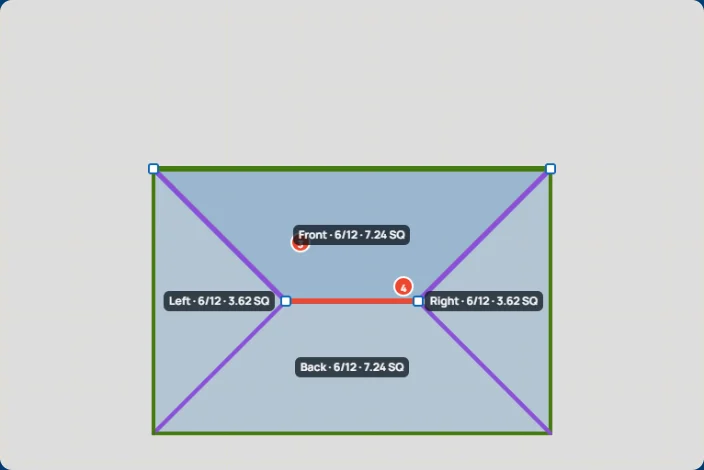
Outline each roof plane on the photo. A simple gable has two planes; a hip roof has four; a cut-up roof can have a dozen. Measure each one separately, because each can have its own pitch. On a clear 1-ft photo, the eaves and ridges are easy to follow.
Step 2: Get each plane's pitch
Pitch is rise over a 12-inch run: a 6/12 roof rises 6 inches for every 12 inches across. You can read it from the attic, from a pitch gauge on the rake, from the homeowner's plans, or from a photo of the gable end. Write it down per plane.
Step 3: Multiply by the pitch multiplier
The multiplier is the length of the sloped rafter for every foot of level run:
| Pitch | Multiplier | 600 sq ft footprint becomes |
|---|---|---|
| 4/12 | 1.054 | 632 sq ft |
| 6/12 | 1.118 | 671 sq ft |
| 8/12 | 1.202 | 721 sq ft |
| 10/12 | 1.302 | 781 sq ft |
| 12/12 | 1.414 | 849 sq ft |
Notice the gap: the same footprint at 12/12 is 217 square feet more roof than at 4/12. Guess the pitch wrong and the materials are wrong before you start.
Step 4: Add the planes, then convert to squares
Add every plane's true area and divide by 100. A roof with two 600 square foot footprints at 6/12 is 2 × 671 = 1,342 square feet, or about 13.4 squares, before your waste.
Step 5: The lengths you'll order by
Area isn't the whole order. Rake edges, hips and valleys are sloped too, so they're longer than they look from above. A rake's true length is its level run times the same pitch multiplier. Hips and valleys run diagonally across two planes, so they need their own factor. When both planes share a pitch:
At 6/12 that factor is √(36 + 288) ÷ 16.97 ≈ 1.061. Skipping it is how jobs come up short on ridge cap and valley material.
How ROI Airstrike does it
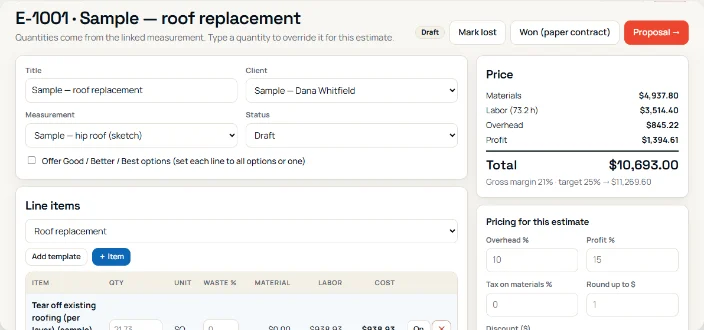
ROI Airstrike is built around exactly these steps. You trace the roof planes on free 1-ft public aerial photos, enter each plane's pitch, and the app works out the true area, rake, hip and valley lengths. If you don't know a pitch, there's a find-the-pitch calculator. Then it prices the job from your own price book, with every number traced back to where it came from, so you (or the homeowner) can check the math.
It doesn't pretend to know the pitch for you. You enter it, the same way you would on paper, and the app does the arithmetic without typos. Our 12-slide presentation shows two University of Central Arkansas fields measured in the app, so you can compare its numbers to dimensions you already know.
Where aerial measuring falls short
- Trees and shadows can hide an eave. Measure what you can see and confirm the rest on site.
- Old photos can miss a new addition. If the house has changed, the photo hasn't.
- Pitch is still on you. No overhead photo shows slope. Get it from the house.
Do those three right and an aerial measurement is a solid starting bid, made before you've climbed anything. Check it on site before you order materials.
Questions people ask
- Can you measure a roof from an aerial photo alone?
- A photo from straight above shows each plane's footprint, not its slope. You still need each plane's pitch. Once you have it, the true area is the footprint times the pitch multiplier.
- What is the pitch multiplier for a 6/12 roof?
- About 1.118. It's the square root of (12 squared plus 6 squared), divided by 12. A 600 square foot footprint at 6/12 is about 671 square feet of roof.
- How many square feet are in a roofing square?
- 100 square feet. Divide the true roof area by 100 to get squares.
Keep reading