The roofing estimate line items that cost you money when you forget them
One missed line item can cost more than a month of software. Here's a checklist of the items that slip off estimates written from memory.
Shingles are the line nobody forgets. It's everything around them that walks off an estimate written from memory at 9 p.m. And it adds up: one missed line item on a roof can cost more than a month of estimating software.
The checklist
Run every bid against this list before it goes out. Each item is sold by the foot or by the piece, which is exactly why it gets lost: the roof is measured in squares, and these aren't.
| Item | Measured by | Why it slips |
|---|---|---|
| Drip edge | Eaves + rakes, linear feet | Rakes are sloped, so they're longer than they look from above |
| Starter strip | Eaves (and rakes, if you run it there) | Folded into "shingles" in your head, not on paper |
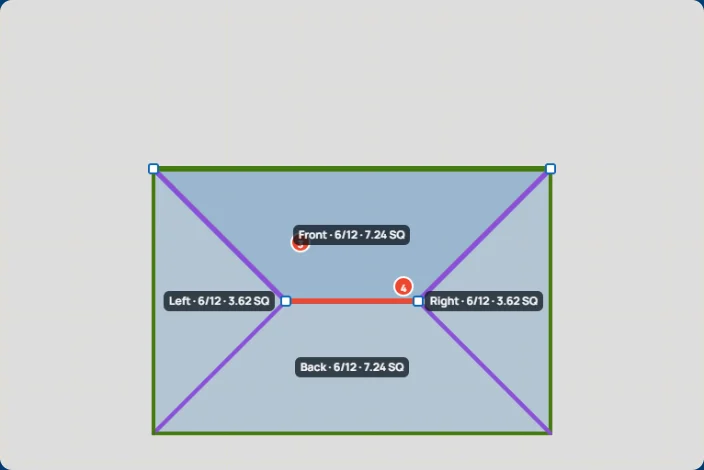
| Ridge and hip cap | Ridges + hips, linear feet | Hips are diagonal; the run on the photo is short of the truth |
| Ice and water shield | Valleys, eaves, around penetrations | Valleys get measured last, if at all |
| Flashing | Walls, chimneys, skylights | Step and counter flashing need separate counts |
| Pipe boots and vents | Each | Counted on the roof, forgotten at the desk |
| Underlayment | Squares | Assumed, never priced |
| Tear-off layers + disposal | Squares, dumpster loads | A second layer is found after the price is signed |
| Permit | Each | Someone else's problem until it isn't |
| Waste | Your factor, per roof type | Buried inside a bundle count |
Measure the lengths, not just the area
Half that list is edges. If your measurement only gives you squares, you're guessing at the rest. Get true rake, hip and valley lengths (they're sloped, so use the pitch) and the edge items price themselves. Our aerial measuring walkthrough shows the pitch math.
Make your price book do the remembering
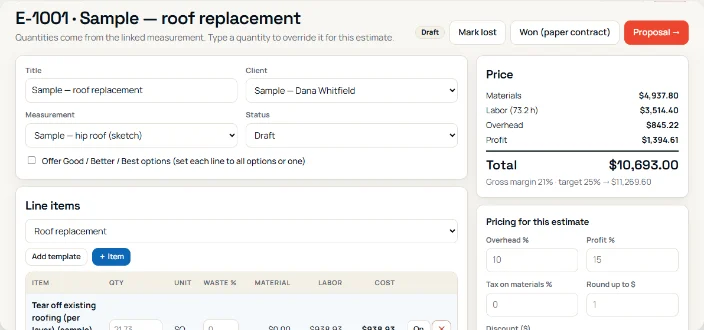
A checklist on the wall helps. A price book that adds the items for you helps more. In ROI Airstrike you build estimates from your own price book (your costs, your waste, your packages, your overhead and profit), with a full trace of every calculation and a scope check for common misses. The measurement feeds the edges straight in, so drip edge and ridge cap come from real lengths instead of a guess.
Then the proposal goes out as Good / Better / Best, the homeowner signs on screen, and the FTC 3-day cancellation notice is built in. Won jobs move across a build board to paid, with invoices, job costing and warranty dates, so you can see afterward whether the estimate held up.
The honest part
No software knows your market's prices. ROI Airstrike starts with sample data so you can see how it works; the numbers that matter are the ones you put in. Spend an hour entering your real costs once, and every estimate after that starts complete.
Questions people ask
- What gets left off roofing estimates most often?
- The edges and the extras: drip edge, starter, ridge cap, valley and wall flashing, pipe boots, vents, extra tear-off layers, disposal and permits. They're small per foot and big per job.
- Should waste be its own line?
- Yes. Put your waste factor where you can see it. A waste number buried inside the bundle count is easy to forget on the next roof.
- Does ROI Airstrike use my prices or yours?
- Yours. It estimates from your own price book: your costs, waste and packages, overhead and profit, with a full calculation trace.
Keep reading